How to Get Started Mountaineering

08/10/09  Print This Post Print This Post    5 Comments   Popular   Written by David DeFranza
  • Stumble It
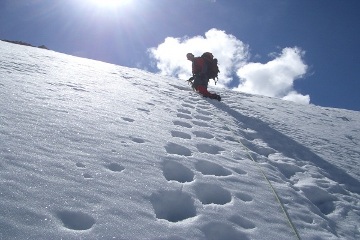
mountaineering photo

Mountaineering gets you higher. Photo from Ezzz

High mountains are nature’s most elegant objectives. Getting to the summits of these peaks requires experience, skill, physical strength, and mental fortitude.
Basic Skills

Mountaineering draws on the full range of outdoor skills, from hiking and camping to climbing and glacier travel. The best way to get started is to master the most basic skills first. Three foundational areas stand out:

Backpacking
Many mountain routes, even on the 8,000 meter peaks of the Himalayas, are really just very long, steep, high-altitude, versions of the hiking trails you can find near your home. The first step, then, is to become comfortable with backpacking, or multi-day hiking, trips. Check out Matador’s guide on how to get started backpacking for more.

winter camping photo

Camping in the winter poses unique challenges.
Photo: Weembles

Winter Camping
While most of the skills you acquire on summer backpacking trips will apply directly to mountaineering, there is one important missing element: cold. To transition from backpacking to mountaineering you must be able to perform all of the common hiking and camping skills, from setting up the tent to cooking, choosing the right clothing to planning adequate meals, in the snow, ice, and cold.

Climbing Fundamentals
You don’t have to be a master rock climber to become a mountaineer. You do, however, need to know the basics. Using a harness, belaying, and tying into a rope are the most important skills. The best ways to learn these skills is to spend a day or two at a climbing gym.

Taking the Next Step

You’re backpacking every weekend. You’ve been to the climbing gym and on several winter camping trips. It’s been fun but now you are ready to head into the mountains. If this sounds like you, it’s time to take the next step. There are several ways to do this, each with it’s own benefits.

Scrambling: Mountaineering often requires travel that, while not always technically difficult, is often very exposed. To get used to these airy positions, try several scrambles: difficult hikes that cross third and fourth class terrain. These steep exposed trails will take you to the limit of what is commonly climbed without a rope, getting your legs, lungs, and head ready for a more serious mountaineering objective.

trekking in nepal photo

The author taking in the view on a trek in Nepal.
Photo: Matt Spinner

International Trekking: Packing your backpack and setting off on a foreign trail presents a whole new set of challenges. Permits, visas, language barriers, and logistics must all be dealt with. Then, there is the opportunity to get very high and deep into true mountain zones on trails that blur the line between hiking and mountaineering. Treks in Nepal, Peru, Bhutan, and other destinations offer a scale that is hard to find in North America.

Take a Class or Hire a Guide: At this point, it is perfectly reasonable to actually do some mountaineering, especially if you are accompanied by someone more experienced. Taking an introduction to mountaineering class or attempting a route with a guide are both great ways to test your skills and build experience in the mountains.

Specialized Gear

Mountaineering will require all the gear you have accumulated for winter camping, and, to a certain extent, rock climbing. There are, however, a few key items that you will need to make the transition.

mountaineering harness photo

A mountaineering harness doesn’t have to be fancy.
Photo: iwona_kellie

Mountaineering Harness: Many climbing harnesses can be used for mountaineering without any problems. To function in the mountains, however, your harness must have enough webbing in the waist to fit over bulky winter clothes, and adjustable leg loops.

Your harness doesn’t have to be fancy: The classic Alpine Bod from Black Diamond is still a favorite and still under $40.

Double Boots: These days, most mountaineering boots consist of a hard plastic outer shell and a soft inner bootie. This is an absolute necessity because it allows you to dry the inner boots in your sleeping bag at night.

Crampons: 12-point, semi-rigid, crampons are the standard for mountaineering. The extra points and flexible instep make them functional on all types of mountain terrain, from flat glacier walks to steep ice climbs.

Piolet Ice Ax: Short, aggressively-curved, ice tools are excellent on steep ice climbs, but for general mountaineering the classic piolet is the ideal ax. Typically 60 to 90 cm long with a gently curved pick, a mountaineering ice ax is important for stability on steep slopes, self arresting in the event of a fall, and chopping steps into snow and ice.

Mountaineering: The Freedom of the Hills: This encyclopedia of climbing is a serious must-read reference for every aspiring mountaineer.

Now that you know how to get started, what are you waiting for? Pack your bag, hit the trail, and soon you’ll be summiting some truely massive mountains.

Community Connection

If you’re thinking of tackling those peaks, check out our review of Survival Straps: Bracelets for More Than a Fashion Emergency,


  • Stumble It

About the Author

Matador ID: ddefranza

David DeFranza is an editor at large for the Matador Network. He has studied in China, worked in Japan, and wandered all over Asia, Europe and North America.

5 Comments... join the discussion!

  • Megan Hill replied on August 10, 2009

    brr, winter camping. that has always seemed nuts to me.

    ↵ Reply
  • Tony Slater replied on August 10, 2009

    Hello!
    Must admit, I found this article disappointing. Where was the information? The title suggested an informative ‘how to’ guide, giving the lay person some solid clues on how to get into a fascinating and adventurous activity – I expected some course suggestions, maybe links and contacts for learning, suggestions for where to pick up instructional videos etc. All this article basically says is: If you want to learn Mountaineering, do a bit of hiking and climbing first. Then find a place and do some mountaineering…
    I’m fairly sure anyone who is interested enough to follow a link to ‘get started in mountaineering’ will know that it involves some walking and climbing – and that the best place to do it is in the mountains… the clue is in the name really.
    In one breath you describe (very basically) some of the tools of the trade, clearly aimed at someone with absolutely no knowledge of the sport – and with the next tell them – ‘now that you know what to do, go and do it!’ Pretty dubious advice…
    Tony

    ↵ Reply
    • Eva replied to Tony Slater on August 11, 2009

      Hi Tony,

      I’m not sure what your level of familiarity with mountaineering is, but as someone who’s a complete novice (hence “how to get started”) I found this article well organized and useful. The various skill sets required were laid out in ascending order – and clearly, the line at the end was intended to tell us to go get started from step one, not to rush off to Everest and kill ourselves. Come on.

      Maybe if you found it too basic, you’re already somewhat familiar with the sport? As for course suggestions and video store locations – in which city, in which country, on which continent? This site has a global readership.

      I thought you actually described the article quite well: “giving the lay person some solid clues on how to get into a fascinating and adventurous activity.”

      ↵ Reply
  • Rory Moulton replied on February 3, 2010

    As an intermediate ski-mountaineer, I’d say this article was spot-on and exactly as advertised. If one completes all the steps (one of which is take a class!), then they should be ready to tackle a basic class-3 climb in summer conditions. For aspiring winter mountaineers, please, please, please take at least a level-2 avalanche course.

    I’d also add that if anyone is truly interested in making this a lifelong pursuit, save up some cash and take a two-week or month-long NOLS course. (Nols.edu). You’ll get all the necessary hard and soft skills and make friends for life.

    Thanks Matador.

    ↵ Reply
  • Kevin Post replied on February 4, 2010

    “Mountaineering: The Freedom of the Hills” is my bible.

    ↵ Reply

Leave a Comment

Jump To Category:


Explore the Community


Latest Community Blogs


Popular Stories on Matador

7 Reasons To Travel With One Bag

... 

30 Funny Travel Quotes To Make You Smile

A collection of classic travel quotes to sharing lighth... 

8 Incredible Survival Stories

Eight of the most amazing tales of survival ever writte... 

Top Gadgets To Travel With In 2010

With newer, ultralight, razor-thin, lightning-fast, adv... 

"Daggering" in Jamaica: A Dance Craze Gone Too Far?

The spiraling popularity of "daggering" -- a "lewd" dan... 

The Dude Abides: The Meaning of 'The Big Lebowski' Ten Years Later

... 


Focus


Editor Blogs