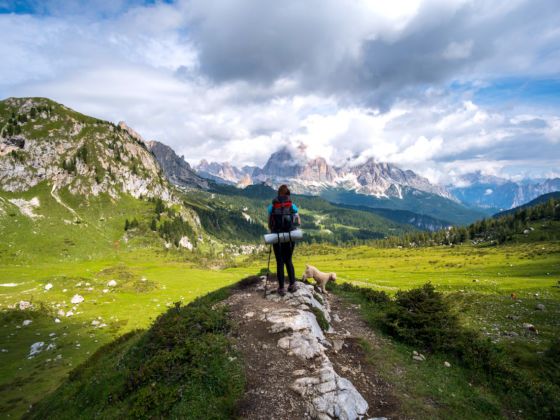
Backpacking is the primary way to get deep in the backcountry. Photo: ledana9
What You Need
Depending on where you will be traveling, whether or not you need to pack for winter, and your level of experience, your pack on a multi-day trip can be a hulking behemoth or a featherweight sack barely heavier than your day pack. Regardless of your destination or the season, however, one rule governs the packing for every backpacking trip: Light is right.
You will be carrying that bag for hours everyday, while negotiating difficult terrain. It is essential that you bring only what you absolutely need and avoid everything else.
That said, there are three main areas to consider when compiling gear for a backpacking trip:
Dealing with traffic on the trail.
Photo: Brian Lane Winfield Moore
Food: Hiking with a heavy pack burns a lot of energy and you will need lots of food to replace those calories. Most backpackers try to balance heavier foods with lighter quick-cooking meals. This is an important consideration because you will also be carrying all the fuel needed to prepare each meal. Cheese, bread, sausages, pasta, and instant dinners and sides are the most commonly carried foods.
Another important consideration when selecting and packing food is its packaging. Cans and jars are heavy and leave you with large containers that must be carried out. Most foods come in extra paper and plastic wrapping that also must be packed out. Instead of filling your pack with boxes, repackage your food in single plastic bags. Most people cut the instructions off the original package and place them in the new bag, just in case.
Shelter: While camping under the stars is great in mild weather, you need some protection from wind, rain, and insects. Many ultra-light backpackers favor tarps but usually you will want a free-standing tent with mosquito netting and a separate rain fly.
Clothing: Generally, the thing that separates the packs of new backpackers from experienced ones is how many clothes they contain. Experienced backpackers know that you do not need much clothing on the trail. A single pair of comfortable shorts with a built-in liner eliminates the need to carry underwear. Regularly rotating between two pairs of socks, and rinsing one pair before bed, means that you only need a single extra pair. Accepting that you will get dirty and smelly means you only need a single tank-top or t-shirt.
The clothes you do need include: an insulating layer (either a light fleece or light wool sweater in summer) and a rain shell that is breathable enough to hike in. It doesn’t seem like much and that’s the entire point.
Essential Skills
Before you begin backpacking, it is important to practice the skills required of both hiking and camping. Some of the most important ones include:
A typical bear-bagging scene. Photo: Jason Pratt
The Bear Necessities: Bears love to eat camper’s food, especially when it’s easy to find in the roadside parking lots and campgrounds of a busy national park. When you venture into the backcountry, however, it is even more important to protect yourself, your food, and the wellbeing of bears and other animals by hanging anything that smells (this includes toothpaste, deodorant, and feminine products) in a bear bag.
To make a bear bag, place all your smellables in a stuff sack or two, tie it to a rope that is strung between two branches 10 feet from the tree trunk and at least 15 feet off the ground. Obviously, this is easier said than done. Practice setting up a bear bag at home before you leave for your first trip.
You are Here?: Even if you plan to stay on well-established trails, some basic map-reading and orienteering skills are necessary. At the very least you should be able to orient a map to a compass bearing and read a topographic map. Not only will this help estimate your general location if you get turned around or take the wrong trail, it will also allow you to identify interesting landmarks along the way.
Playing Doctor: Knowledge of some basic first aid, like cleaning and dressing a wound, is very important when venturing into the backcountry. More important, however, is knowing how to prevent and treat blisters, hypothermia, heat stroke, and dehydration. These maladies are much more common on trail than the fractured femur that requires a traction splint to be made from a ski pole.
Take Only Pictures: Along with “light is right,” the motto of every backpacker is “take only pictures, leave only footprints.” This is an easy way of invoking the core principals of Leave No Trace. The ideas are simple, but practicing them with diligence is vitally important.
Where to Go:
Once you have the gear and the skills you need to start backpacking, it’s time to hit the trail. But where should you go?
National Parks: In the United States, backpacking is an exceptional way to experience national parks. While the roadside campgrounds are crowded and cost money, the backcountry sites, some only a mile or two down the trail, are free and often empty even at the peak of the summer. Once you get a day or two from the road, it is like you have entered an entirely different place: one marked by solitude, wildness, and pristine natural beauty.
A trail marker on the Appalachian Trail.
Photo: D3 San Francisco
The Appalachian Trail: On the East Coast, the Appalachian Trail offers a 2,175 mile venue for backpacking. A complete “thru-hike” is the dream of many experienced backpackers, but hiking even a small section of the trail over a weekend is a great way to introduce yourself to the pursuit.
International Trekking: Almost every country, from Nepal to Papua New Guinea, Borneo to Peru, Laos to Bhutan, and many more, offers an opportunity for some truly spectacular trekking.
Backpacking gives the hiker a new feeling of independence, self sufficiency, and responsibility. It also provides an opportunity to escape the modern world and enter one in which nature still rules. As John Muir said,
In every walk with nature one receives far more than he seeks.
Community Connection
CONTEST!
We’re running a mini-contest here at Sports! Give us 2 or 3 paragraphs on your first backpacking trip. Where did you go? When? What happened? What did you pack that you never used? What did you find you needed but didn’t have? What happened along the way?

Just add your story to the comments below. We’ll choose our favorite–and the winner will receive a copy of Alexandre and Sonia Poussin’s books Africa Trek Vol 1. from Cape to Kili and Vol 2. from Kili to the Sea of Galilea.
Alexandre and Sonia Poussin walked the length of Africa entirely on foot, from the Cape of Good Hope to the Sea of Galilee, over three years, eleven countries, and staying with 1,200 families, without sponsors, or a support team.
About the Author
Related Posts
12 Comments... join the discussion!
-
-
that’s hilarious, hal. Colorado highcountry has a way of handing people’s asses back to them.
Marble rocks! Love that hold corner of the world. Crystal river. Here’s a photo of me running that at high-water about 8 miles upstream from Marble:
↵ -
Heh. I wonder how many of these “first backpacking trip” stories are going to be nightmares? I know mine is!
I was at summer camp in rural Quebec, summer after 6th grade I think. (I went to an all-vegetarian, all-holistic, sugar-free summer camp, though that doesn’t really bear on the story all that much.) I signed up for a multi-day hiking/camping trip with 10 other girls between the ages of 8 and 12, plus two 16 year old trippers. We hiked in the first couple hours with our packs, and then one tripper took all our gear in a canoe and the rest of us headed down the trail, intending to go around the lake and meet her at the site. Unfortunately, we took a wrong turn – I guess we didn’t realize it for awhile, because by the time we knew we were off course we’d been walking into woods for maybe an hour.
At any rate, we broke every rule. Instead of staying put, we kept walking. Not long after we realized we were lost, it started thundering and pouring rain. I still feel for the tripper who had to handle 10 screaming, crying pre-teen girls lost in the woods. We never made it to camp. Fast forward several hours, and by this time police with sniffer dogs were combing the woods for us. A helicopter was on its way from the nearest search and rescue station. We were walking in circles just trying to stay warm – none of us had a thing with us besides shorts and t-shirts. In the end, it was another camp counselor who found us – I can still remember when we spotted him ahead of us and all broke down bawling and running to jump on him. Back at camp, the homeopathic nurse gave us all brandy and rescue remedy.
I’m over it now, but would it shock you to know I didn’t go camping again for several years?
↵ -
Great story, Eva! And I thought mine was a disaster…
↵ -
Well, to say the least, my first hike was a roller coaster. And by that things are extremely pleasant and damn this is awful on an interesting first hike. It came in Arizona and was possibly the most influential part of my short span on this Earth. Ahead of me was 7 long weeks filled with blood, sweat, epiphanies, thrift stores, buffets, dried foods, trail work, 90 degree weather, and no communication. Hold your horses, this is about to get McNasty. Our trail crew had just finished a 34 hour bus ride from Eugene, OR to the Saguaro National Park in Tucson, AZ. Leg’s stiff, our bodies tired, we were as ready ever to take on the desert.
Our first hike, and my first personal big hike, was 11 miles. My immediate mistake was wearing steel toe boots. It’s equivalent to wearing a parka and snow pants to the beach. The packs we had to bring in with tools, gear, and tents weighed in the neighborhood of roughly a human being. So about 100+ pounds. After 11 hours hiking just over 10 miles we neared our junction. Every muscle in my body was screaming. One leg just went dead, so I dragged the puppy. World record of swears for a 10 person group was achieved. My personal count at hour ten was at least 2,000 F words. What was incredible, however, was the immediate sense of peace and accomplishment from hiking. At just under 7,000 ft, it was by far the most memorable view of my life. A beautiful, quiet, and untouched landscape can have a mysterious and powerful effect on the soul.
Here was my conclusion.
1. Dear God, I think I’m seriously gonna die. (around mile eleven)
2. Mmmm, I wish I had toilet paper and non-iodine water.
3. Man-O-Man I can’t wait until my next hike.↵ -
Congrats, Neal; you’re the winner of our contest!
Please contact me at julie@matadornetwork.com to indicate your address so we can send you Alexandre’s books!↵ -
My first backpacking adventure was in the urban jungles of Europe. After college, a friend and I grabbed Eurail passes, backpacks and a box of Luna bars, and hopped on a plane bound for Paris (via Reykjavik). We brought way too many clothes, way too little camping soap to wash out those clothes in hostel (or hostile, depending on the city) sinks, but just the right amount of clueless optimism. The top two things I learned about backpacking around Europe:
1.Try to make reservations, or at least know where some potential lodgings might be. Nothing can ruin a city faster than wasting a day wandering around with a pack on your back (My first impressions of Florence were forever tainted).
2.Never think you’ll be able to sleep sitting up on an overnight train. After a night spent pushing a drunk dude’s head repeatedly off my shoulder, I would’ve gladly paid extra for a sleeping car.
↵ -
Great article. I think you really hit the nail on the head, especially when you were discussing appropriate clothing to take. It’s very common for first-time backpackers to overpack on their first trip, so this is a great guide for beginners.
One important thing that I think this article overlooked is hydration. As an avid hiker/backpacker, I can’t stress enough what a difference it makes if you’re well hydrated before (and, of course, during) your trip. I’d recommend drinking a supplement (nuun, Camelbak Elixir, etc.) infused bottle of water the day before and the day of your trip. Additionally, be sure to pack a water filter/purifier and/or plenty of iodine/purification tablets. You DO NOT want to get caught in the wilderness without a steady supply of clean water, so this is the one area where I would definitely recommend overpacking, just to be on the safe side. Tablets are small and practically weightless, so I repeat, BRING EXTRA.
I hope everyone has a safe and happy trip on their next adventure!
↵


