First Timer’s Guide to the Climbing Gym

06/9/09  Print This Post Print This Post    4 Comments   Popular   Written by David DeFranza
  • Stumble It
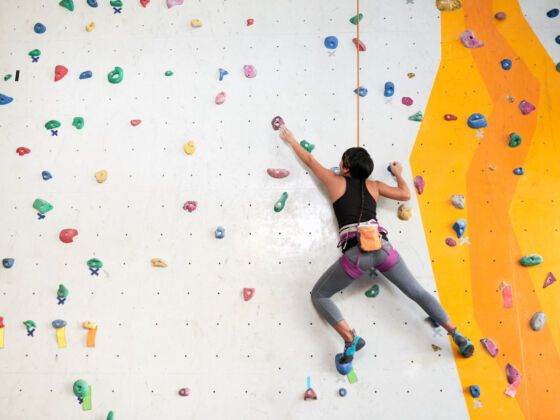
bouldering wall photo

The climbing gym can be intimidating. Photo: amrufm

A climbing gym can be an intimidating place, especially if it’s your first time. But if you get a quick heads up on the basics, and just go with an open attitude, you’ll find it to be more fun than anything else.

What You Need

The first thing to think about are the clothes you will wear. It’s best to wear loose fitting clothes that allow for a free range of movement and that you will feel comfortable in.

Shorts are fine, but many climbers prefer pants because they reduce the chance of scraping your knees and legs. Also keep in mind that a climbing harness has straps that run around your thighs, roughly where the bottom of a short pair of shorts would sit.

Other gear you will need includes a pair of climbing shoes, a harness, and, if you are approved, a belay device and large asymmetrical or “pear-shaped” carabiner. All of these things will be available to rent, usually for a small additional fee, from the gym.

Knots, Belays, and Safety

belay session photo

Getting ready to belay and climb. Photo: iwona_kellie

There are a lot of pieces of equipment, knots, and techniques climbers use to make a seemingly dangerous activity as safe as possible.

The gym will likely require you to take a short lesson before you’re allowed to climb. Expect to learn a knot, the figure eight, and how to use it to connect your harness to the rope.

The rope is controlled by your partner through a process called belaying. Essentially, belaying uses a mechanical device to apply friction to the rope. When the maximum amount is applied (in the case of a fall for example) the rope and climber are held in one place. When friction is reduced, the rope and climber can move freely.

All gyms require climbers to, at the very least, take a test before they are allowed to belay. The staff will also be willing to teach you how, but may only be available do so during certain times.

When climbing, safety is paramount. Climbing gyms typically have a robust system in place to ensure everyone is behaving properly and climbing safely. Still, be sure to pay attention to what is going on around you, ask questions, and don’t hesitate to say something if at anytime you feel comfortable.

Routes and Grades

climbing holds photo

Routes in the climbing gym are marked with colored tape.
Photo: iwona_kellie

On the walls of the gym, you will see lots of different holds and most will be marked by a strip or two of colored tape. This tape identifies specific routes on the wall. A red route, for example, could be done by only using holds marked with red tape for your hands and feet.

Gyms also grade their routes. Most use the Yosemite Decimal System, which is the standard for climbs in the United States both indoors and out. Under this system, 5.0 is the easiest and the hardest done to date is around 5.15. It’s an open ended scale though, so someday you may hear of 5.16 or even 5.20.

First-time climbers usually fall within the 5.4 to 5.8 range.

Learn the Lingo

Climbers have their own way of talking about their sport and climbing in a gym can be confusing if you don’t know the lingo. Here are some basics:

Beta: Information about a climb.

Flash: Climbing a route from the ground without falling on your first try.

On Belay: A question the climber asks the belayer to ensure the safety system is ready. The belayer responds “Belay on” if she is ready for the climber to begin.

Red point: Climbing a route your have tried before from the ground up without falling.

Send: Climbing a route from the ground up without falling.

Now that you know the basics it’s time to tie in and try a route. On belay!

Community Connection

Looking for someone to go climbing with? Search out people wherever you are through Matador.


  • Stumble It

About the Author

Matador ID: ddefranza

David DeFranza is an editor at large for the Matador Network. He has studied in China, worked in Japan, and wandered all over Asia, Europe and North America.

4 Comments... join the discussion!

  • Ryukyu Mike replied on June 9, 2009

    This is the kind of post I like to see; something that makes you want to learn more. It’s informative, easy to understand and explains why’n hell they painted all them rocks different colors. Think I’ll put on some bluejeans and make the show the Grandkids how to do it right!

    ↵ Reply
  • Julie replied on June 9, 2009

    I love rock climbing. I’m 100% not athletic, but it’s always an activity I’ve enjoyed– great, informative article, David!

    ↵ Reply
  • Hal replied on June 10, 2009

    Can’t wait to get back in the gym. David, thanks for keeping the fires stoked till then.

    ↵ Reply

Leave a Comment

Jump To Category:


Popular Stories on Matador

What's In Your Backpack, Tony Vincent, Recording Artist and Broadway Actor?

From performing with the award winning Broadway show, R... 

5 Choice Spots to Enjoy Spring Blooms

Spring has come to the northern hemisphere. Here are so... 

How To Bake Your Own Amazingly Easy, Incredible Bread

Join the artisan bread revolution today!... 

Introducing the Matador Store

Pick up a t-shirt and send us shots of you exploring th... 

Photo Essay: 10 Reasons to Love Brazil

Modern gonzo Robin Esrock and partner Ana Alheiro lay o... 

Someday Syndrome & the System of I-Can’ts

Or why I left my five year old standing in a raging riv... 

The Minority Perspective

I returned to America with a strong belief in the impor... 

20 Athletes Pushing the Most Insane Limits on Water, Land, or Air

Dudes flying 100 miles an hour just inches away from a ... 

10 Brands That Don’t Deserve To Declare Themselves “Green”

... 

Photo Essay: The Mountains of Kyrgyzstan

Sophie Ibbotson photographs her adopted home of Kyrgyzs... 


Focus


Editor Blogs