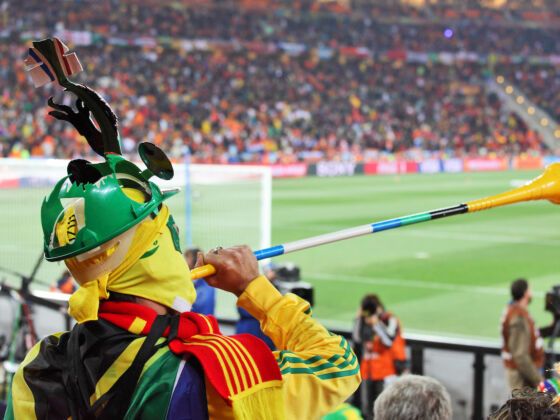
Photo: TPower1978 / Feature: Vincent Teeuwen
Whenever people tell me that soccer will never be popular in the US, they usually give me the same two reasons: soccer is too slow, and there’s not enough scoring. I tell them to go watch the Netherlands national team play.
The Dutch game is a rebuttal to American’s gripes with soccer. The Dutch are fast, and they play nonstop offense. There’s very little stalling and no endless, circular passing. The forwards attack. The midfielders attack. As soon as the Dutch get the ball, they move it straight toward the goal. It’s the kind of soccer Americans could get used to.
Total Football
The Netherlands’ style is based on a theory of soccer called Totaalvoetbal, or Total Football. First developed at club Ajax of Amsterdam, the idea behind Total Football is that any player should be able to fill any position on the field. If a defender moves forward to score, a midfielder can move back and defend, or vice-versa. The system encourages fast, aggressive play by letting the team attack from any point on the field without leaving gaps in its defense
Photo By: Vincent Teeuwen
The problem is that modern soccer is becoming a defensive game. Teams would rather shut out their opponents than outscore them.
As an example, there were no scoreless games in the 1950 World Cup, while seven games at the 2006 World Cup ended zero-zero.
The current champion is Italy, whose traditional, ultra-defensive strategy, called cattenacio, focuses more on locking down the goal than on scoring. It can be boring to watch, but it often wins games.
Team could compromise playing style
While the Dutch have never won a World Cup, they’re looking stronger this year than they have in a long time. Under new coach Bert van Marwijk, the Netherlands qualified for South Africa with eight straight wins. The team has some of the strongest offensive players around, like Arjen Robben and Dirk Kuyt.
Still, the Dutch say they’ll compromise their style and play defensively if it will help them in the World Cup. As defender Andre Ooijer said in an interview with the AP, “We’ve learned to win without playing well.”
Defensive soccer isn’t going to win the sport any new fans in the US. It’s not that we don’t appreciate tactical, creative play. We appreciate it just fine, as long as it ends in scoring. Without that, I can’t imagine soccer ever arousing more than sideshow-level curiosity in the mainstream American media. No matter how well the US national team does, Americans will continue ignoring soccer for as long as they continue to think it’s a futile sport.
But if a country like the Netherlands were to win the World Cup by playing a fast, offense-heavy game, it could help convince Americans that soccer is actually worth watching.
Community Connection
Get psyched for World Cup 2010 on Matador Sports.
Jeff Bartlett gives two reasons why soccer will never be popular in North America.
About the Author
Related Posts
10 Comments... join the discussion!
-
-
Hi Stephen,
It’s an interesting idea, and I’d like to think you’re right, but I don’t know if I agree. No, it’s certainly not an unknown sport the way rugby is, but that doesn’t make it popular the way baseball, basketball, or even hockey (ouch) is popular in the US.
In my view, Americans have accepted soccer as a spectacle. They know the Brazilians because they do fancy tricks, and they know David Beckham because, well, he’s David Beckham. But how many ever sit down and watch MLS games on TV? How many even know who their local MLS teams even are? Outside of a few specific communities, the game doesn’t have much in the way of widespread popularity outside of World Cup years.
↵ -
I beg to differ on a few accounts.
The Dutch are not fast. They have a few fast players, namely Arjen Robben and Roben Van Persie, but they are not a fast team. Brazil, France, England, Spain, Portugal are fast teams. The Dutch football is fast. They move the ball quicker, there are less touches between passes; this is what provides them with a quicker game.
I don’t believe that it will require only the Dutch winning the World Cup to make soccer popular in America. Soccer is already the fastest growing sport in the United States.
http://www.mediapost.com/publications/?fa=Articles.showArticle&art_aid=125566
http://homepages.sover.net/~spectrum/culture.html
The first link is an article outlining that point.
The second link is published research that supports it.As with a lot of people, my friends that harbored a disinterest in soccer before they became friends with me simply did not understand why it was interesting. Once they sat down with me, and gave up their attitudes and preconceived notions, and started understanding why I was so impressed with the way a player brings the ball down, or the dribbles, or the almost passes, they started getting just as excited too. When they went outside and started trying to handle the balls and realized how difficult it actually was, there respect only grew more.
So, I don’t think soccer’s popularity can only be achieved through the success of the Dutch national team, in fact I think it’s unlikely that that would result in a huge stream of popularity. It might turn a couple people on the fence.
Instead, I see soccer continue to grow at a relative rate. The more people come to know about soccer and gain the passion that I and other players have, or at least an understanding of that passion and maybe a little of their own, the more it will gain in popularity.
Also, it’s Dirk Kuyt, not Dick.
↵ -
This is a central debate in any sport when it comes time for the ruling body to update the laws of the game. In 1925, when the offside rule was changed to “two players” instead of 3, goals scored jumped 50%. I have no doubt that every time FIFA executives meet, they discuss how to improve the laws of the game to speed it up and produce more goals. High-scoring games are more fun to watch; the jerseys of the highest-scoring players are in highest demand; players that score a lot usually end up winning awards and scoring expensive endorsement deals.
But soccer’s popularity in the US can’t be wholly attributed to the pace of the game. Baseball is an incredibly slow sport. Games are usually very low-scoring and can last two or three times as long as a soccer match. The MLB struggles with rule changes to increase the speed of the game every year. Yet baseball continues to be an extremely popular sport in America. I don’t know how people can sit down and watch an entire baseball game, but they do.
Part of the problem, like Jared said, is lack of knowledge about the game. Whenever people learn more about the rules of a game, about strategy behind decisions, and about popular culture surrounding the sport, interest grows. I expect the ‘94 WC in the US provided such a bump in interest.
The MLS tried to capitalize on it, but the MLS sucks. First of all, team names are terrible, and don’t inspire anyone. The “Earthquakes”, “Rapids”, “Revolution”, “Dynamo”, “Whitecaps” all sound more like natural disasters than fierce competitors. The league was built as a money-making scheme rather than for the love of the sport. People can see through it. They use fad tiebreaker rules to try to increase game excitement but it ends up just making the sport seem cheap. The MLS is the reason that soccer isn’t “popular” in the US.
↵


