What Can Scuba Teach Us About Travel?

10/28/09  Print This Post Print This Post    4 Comments      Written by Jonny Finity
    Share

Photo: hoyasmeg

Over 60% of our planet is covered by water. Most of us only skim its surface.

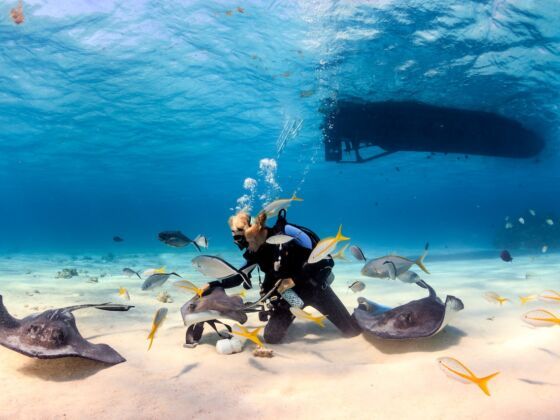
Scuba divers like to go deep and stay there for a while. They want to better understand the ocean environment, to feel as much like a fish as possible.

Any scuba dive course will teach you some crucial, potentially life-saving information. It just so happens that it can also give you a few travel tips to help you immerse yourself abroad as well.

1. Breathe

This may sound like a no-brainer. Breathing is the most natural thing in the world. If you stop breathing until you pass out, your body will pick it right back up again.

It’s more important underwater. If you hold your breath while scuba diving, sudden changes in pressure can rupture your lungs.
When you’re in a new environment, it’s easy to get sucked in and forget to forget how your body is reacting.

When the airline loses your bag or a cockroach sets up camp in your hotel room, take a deep breath: everything will be OK.

2. Go slow and steady

The easiest way to spot seasoned divers is by their movements – they don’t thrash around or race from one reef to the next. They move slowly and steadily through the water, working with the ocean currents to conserve energy.

They could cover more distance by swimming faster, but they would deplete their air supply quickly and probably swim right past some of the most unusual and sought-after marine life.

If you jump from one guidebook destination to the next, you’ll end up with a lot of pictures to show people back home, but chances are you won’t understand those people or places much better than you did before. You’ll get the most out of your travels if you take the time to slow down.

Photo: Andrew

3. Equalize often

Underwater, air pockets in divers’ middle ears are squeezed by water pressure. Divers need to stop every few feet and “pop” their ears to equalize them. If they descend without giving their bodies time to adjust, the increasing pressure can cause their eardrums to implode.

Cultural and language differences, rapid climate changes, and an unusual diet can wreak havoc on your body. You need time – both physically and mentally – to adjust to the pressures of travel.

Traveling may not seem like work, but it can be just as taxing. Plan a day to relax – read a book, write in your journal, or take a nap in a hammock.

4. Deeper is (usually) better

Anyone with a snorkel and mask can ogle some pretty fish from the surface. Having an air tank gives you time to get comfortable, and let the local fauna get comfortable with you.

At popular snorkel sites, the aquatic life may be used to human traffic. But in deeper waters, fish will be wary of intruders into their habitat. It also takes time for them to relax and accept you.

If you want to really understand another culture, you have to become a part of it. It takes time to earn people’s trust, but spending that time is well worth it. Not only can you develop meaningful, lasting relationships, but you will discover adventures and experiences only the locals know about.

Photo: DiveKarma

5. Don’t ascend too fast

Just as scuba divers need to be concerned about getting “the bends” by ascending too quickly from a dive, travelers should be cautious about reverse culture shock.

Leaving home for a foreign land can be daunting. As a responsible and conscientious traveler, you probably spend a lot of time before a trip planning for the journey ahead. You learn a few greetings, how to say “thank you”, and to take your shoes off before entering someone’s house.

Going home to a land of supersized supermarkets and designer jeans can be equally overwhelming. Plan your reentry just as you did your departure, and you’ll lessen the depression and discomfort that often sets in.

Community Connection

Take a dive with Matador Sports’ The Polar Plunge: 5 Cold-Water Dive Destinations.

Matador Sports editor Adam Roy shares some of his own stories of the sport in Emergency: 11 Memories From 8 Years of Scuba.


    Share

About the Author

Matador ID: jonnyontheroad

Jonny Finity is cheap, dirty, and shiftless. He spent two years in Kenya with the Peace Corps, where he starred in a Swahili music video and recorded a rap song about HIV. He currently lives in South Korea. He loves to eat with chopsticks.

4 Comments... join the discussion!

  • rich replied on October 30, 2009

    Hey Jonny, Great article about essential diving skills. If there was one thing I’d add it would be to keep your equipment in excellent shape. I’ve always found the best visibility and most beautiful corals between 20 and 60 feet.

    ↵ Reply
  • Nancy Bauer replied on October 31, 2009

    Hi Jonny – fun article, and the part about not ascending too fast really hit the mark – you don’t have to be gone long to experience that feeling of being overwhelmed when you come home. Especially when you live in a heavy population and high traffic area like I do outside D.C. – it’s soul sucking. I wrote a blog post not too long ago about how diving – especially shore diving – can help you slip easily into a new location…here: http://www.shoredivelife.com/2009/04/diving-for-expats-and-everybody-else.html

    Thanks again.
    Nancy, ShoreDiveLife.com

    ↵ Reply
  • Tony Allegretti replied on November 2, 2009

    Nice article. Deeper is Better, but you do not want to bring any corals to the surface to give to your friends;) Leaving things the way you found them may apply to your analogy as well.

    ↵ Reply
  • neha replied on November 5, 2009

    Great piece! Really enjoyed reading this.

    ↵ Reply

Leave a Comment

Get Matador in your inbox and around the web.

Sign up for our FREE weekly newsletter.


View full list of RSS feeds

Jump To Category:


Explore the Community


Popular Stories on Matador

Why Science Needs To Bring Sexy Back

The scientific community is failing to elicit a sense o... 

How to Couchsurf Without A Couch

From camping trips to city tours, piss ups to opera out... 

Surfers and Sport Anglers Speak Out On BP Oil Spill

"We don't know what the future holds, but the beaches l... 

13 Classic Japanese Junk Foods

Think of a long and perfectly cylindrical Cheeto, with ... 

Travel vs The Internet

Jacob Bielanski asks, "Does the internet cheapen your t... 

Grow Some Moss in Your Bathroom

A soft grass carpet that thrives from the few drops of ... 

10 Drink Recipes You Can Light On Fire

Put a shallow layer of 151-proof rum on top. Light the ... 

6 Prisons to Visit on 6 Continents

Creator of 501Places, Andy Jarosz, takes a different an... 

How Climbers Can Help Pakistan Rebuild

A senior official at the Red Cross has said that rebuil... 

Guide to Kenya's National Parks

From the reaching equatorial glaciers on Mt. Kenya to p... 


Focus


Editor Blogs