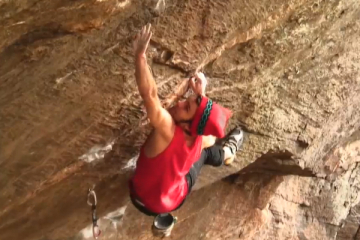
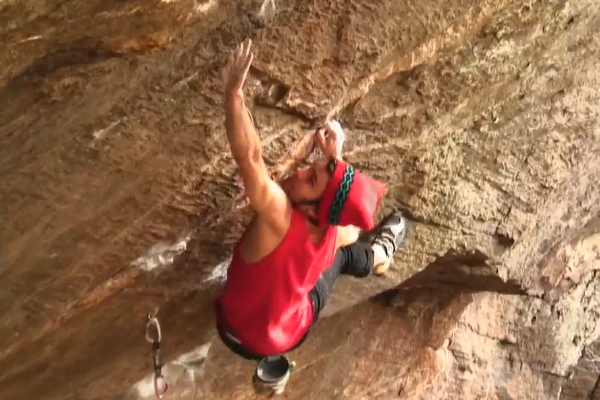
For those of you who haven’t heard the story, on October 18th, Zolotukhin suffered an accident while attempting a ropeless ascent of Supernova, a 5.14b route at Rumney’s Starship Wall in New Hampshire. Taylor de Lench, a filmmaker and friend of Zolotukhin, was on site to film the climb for his upcoming film SICK: Climbing in New England.
In the video, Zolotukhin starts out strong, making his way through some half-dozen moves with no apparent problems. Then, at about twenty feet up, his hand slips from a hold and he falls. From there, the video becomes genuinely unpleasant to watch.
“The second I hit I knew things had gone wrong,” writes Zolotukhin on the Boston Rock Gym’s blog. “My foot was facing due west instead of straight ahead like a normal foot should.”
But besides broken bones, Zolotukhin got something that very few free soloers get – a second chance.
“My lessons were clear,” he writes. “DON’T be overconfident; DON’T assume that everything will be okay.”
As a general rule, there are no failed attempts in free soloing: there are successful summits, and there are fatalities. A significant chunk of the discipline’s big names, like John Bachar, Derek Hersey, and Michael Reardon, met their ends in climbing accidents, many of which could have been avoided by the use of safety ropes.
The accident has provoked discussion within the climbing community about what constitutes responsible free soloing. Many climbers have highlighted the importance of a good attitude to free soloing or highballing, with some pointing out Zolothukin’s own admission that he pushed himself to climb the route despite not feeling sure of his ability to do so.
World-class free solo climbers like Alex Honnold are legendary for being cool-headed even under the worst pressure, and it’s not hard to see why. When all that separates you from a fatal fall is your grip on a dime-sized nub of granite, you’d better not flinch.
Still, it’s difficult to talk about safety in a discipline defined mostly by its rejection of safety equipment. As Zolothukin’s friend Gavin Heverly writes on his blog, not even free soloing pros can escape the danger.
“[Honnold's] free-solos are awe-inspiring and downright impressive. But they are also mind-numbingly stupid,” writes Heverly. “Dying doing something you love is in a way amazing. But…I mean, wouldn’t you rather CONTINUE to do what you love?”
Community Connection
Is free soloing worth the risk, or is it inherently irresponsible? Tell us what you think in the comments section.
About the Author
Related Posts
2 Comments... join the discussion!
-
-
Soloing isn’t necesarily about a rush, but more a calmness that come from being under control. A similar feeling to that felt while climbing extremely run out routes.
I discussed just this topic more than a couple of times with Derek Hersey mentioned in the fourth paragraph.
Some thoughts.
Soloing should be done with the knowledge and acceptance that the price of failure is death. If one doesn’t understand and fully appreciate the consequences one shouldn’t solo.
Climbing ropeless twenty feet off the ground is more akin to high altitude bouldering, not free soloing.
Free soloing, especialy routes that haven’t been rehearsed leaves no ambiguity as to ethics. So many people climb at what is in reality far above their ablilities these days. Soloing teaches one to truly asses ones abilities, failure to recognise one’s limitiations can ruin your day.
Lastly some choice quotes from Derek. The first while belaying he sits right on top of the bad anchors he spent half an hour trying to find and set up securely so that I can’t see the anchors at all and assume him to have none. When I reach the crux and can see his seeming lack of anchors he looks over, gives a serious look, and dead pans, “Don’t fall or we both go”.
The other while simulsoloing the exit from a long route he looks back and says, “slip now and you’ll fall the rest of your life”.
I’m now old fat weak and have trouble climbing out of bed.
↵


