How to Paddle Out to a Famous or Localized Surf Break and Get Respect

06/15/09  Print This Post Print This Post    7 Comments   Popular   Written by Gabe Cabagbag
    Share

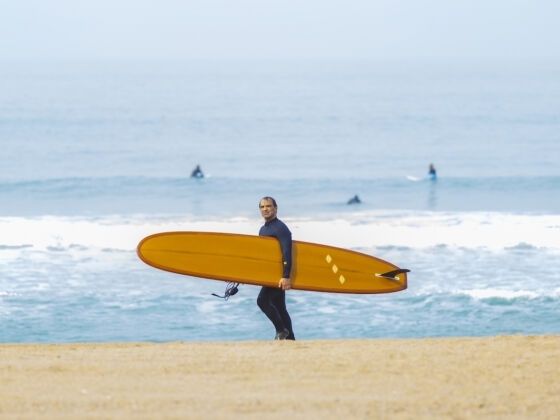
Getting respect starts with giving respect from the moment you arrive at a spot. Even if you’re intimidated, say what’s up to people; don’t act like they’re not there. Ask someone if you can follow them out or study how the locals are paddling out and give them time. Photo: Wonderlane

Unless you’re Kelly Slater, locals aren’t going to hand you waves. It’s about respect. Here’s what to consider before paddling out somewhere heavy or localized.

Every break has its own set of rules and hierarchy. The heavier the wave, the heavier the enforcement. While there are many localized variations of surfing etiquette depending on the spot, almost all of the world’s surf breaks are run by two basic rules:

*Don’t snake or drop in on another surfer who is already riding the wave. This puts everyone at risk for serious injury.

*Wait your turn. Don’t paddle past all of the other surfers who were waiting and just go straight to the peak. You will be met by the Uncles (as we call them here in Hawaii) or Godfathers, and unless you’re a local, they will definitely tell you to paddle to the back or go home.

In addition to those two universal rules, here a few more things to think about:


Take your time before you paddle out.

Observe the area. Watch the lineup closely for a while and take mental notes on where the sets start breaking, where the best place is to paddle out, how many waves are being ridden, and whose doing the riding. Knowing these questions by simply taking the time to survey the break will certainly save you time and energy before heading out.

I usually determine all of this within ten minutes of observation, maybe a bit longer for the heavier spots.

Two’s a company, three’s a crowd.

Don’t come rolling up to a spot with your whole posse. If you think about it, charging the surf along with five of your bros will change everything about the session, especially if there are only a few surfers out. Be aware of the amount of people already out in the lineup. A good rule of thumb is to avoid increasing the numbers in the water by more than 25%.

Let the locals set the rhythm.

Photo: Mike Baird.

Take your cues from their actions and let them determine the pace. Do not try to out surf the locals. It doesn’t matter if you’re more skilled than them.

Try to take over the waves at that spot, and a local (or more than one) will almost certainly use his or her superior knowledge of the spot to confuse and frustrate you.

I remember one time when I was surfing my local break at Kewalos. Five guys arrived on the scene and paddled straight to the top at the peak, cutting in front of everyone else including the Uncles, who told them to wait their turn.

Ignoring them, one by one they each caught a wave.

That was the only ride they would ever get, as they were then totally bitched at and told to paddle back in, where they were being awaited for more heckling by the rest of the local posse on the shore.

Initially as a visitor, you’ll simply just have to take what is handed to you. Over time you will slowly start to see more chances open up for you as each session goes by.

If I wanted respect, yet were new and inexperienced to the spot, I would just sit on the inside or shoulder of the wave and catch the leftover waves left behind by the locals. Eventually, they’ll say “This guy’s cool: just minding his own business, maybe we’ll give him some waves.”

Arrive and leave the place on a good note.

When you paddle into the lineup next to someone, talk story first. Be friendly. A simple “What’s up man, how’s the waves today?” is a lot better than just sitting there and floating around pretending like he or she doesn’t exist.

When leaving, thank your fellow surfers for sharing the spot and apologize to anyone you might have dropped in on by mistake. Let them know they’re welcome to visit your home break in return. Simple gestures like these go a long way.

–Feature photo: Brett Wagner.

Community Connection

Looking for some great surf and travel guides? Check out Matador’s archive of surf stories from Vietnam to Portugal, Hawaii and beyond.


    Share

About the Author

Matador ID: gabe

Gabe Cabagbag is a surfer and wanderer at heart who just wants to see the rest of the world before he turns into a saggy prune. He likes to draw and take pictures too.

7 Comments... join the discussion!

  • joshywashington replied on June 15, 2009

    Amazing feature pic and great article Gabe. I tried surfing one fated Costa Rican afternoon and after 3 hours of getting pounded trying to duck dive and nipple pain i wouldn’t wish on anyone I left it to the big boys and reclined under a palm tree.

    ↵ Reply
  • clegs replied on July 31, 2009

    This is a great short and sweet article about surfing and etiquette. Thanks Gabe for spreading the knowledge :)

    ↵ Reply

Leave a Comment

Get Matador in your inbox and around the web.

Sign up for our FREE weekly newsletter.


View full list of RSS feeds

Jump To Category:


Explore the Community


Popular Stories on Matador

How to Ride the Tram in Amsterdam

Abbie Mood picks up some public transport skills during... 

Finding Myself Back in San Francisco

Just one afternoon during a return trip to San Francisc... 

Back to Sender

Lola Akinmade is confronted with the energetic survival... 

Abby Sunderland Lost and Found at Sea

16-year-old solo sailor makes it to shore safely after ... 

Family vs. Travel: The Regret of the Road Not Taken

We all make choices when traveling. Often, choosing one... 

Technology Bytes: Develop iPhone and Android Apps Online

Two companies have introduced a way for those without p... 

The Most Obscene Debate On the Internet

Warning: You may find the photos in this article to be ... 

Experience the Art of Improv Travel

Travel is more about how you do it, not where you go. F... 

Travel vs The Internet

Jacob Bielanski asks, "Does the internet cheapen your t... 

Backpacking After Baby

Traveling and trekking don't have to end when a baby jo... 


Focus


Editor Blogs