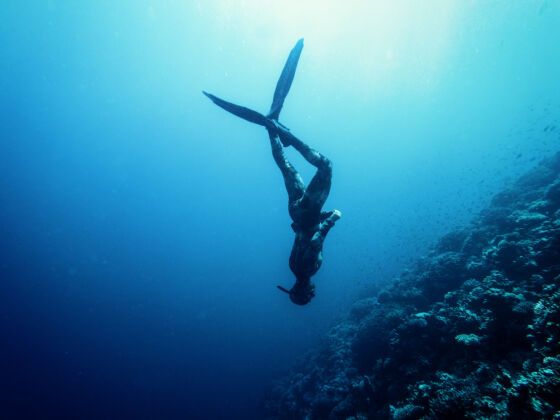
3 Exercises for Free Divers

08/13/09  Print This Post Print This Post    2 Comments   Popular   Written by Adam Roy
    Share

Photo: jayhem

Exercises to train divers’ brains as well as bodies.

There’s something about master free divers that goes beyond athleticism. Expert free diving is almost Zen-like, a union between athlete and environment.

If you’re looking to master the sport, it’s as important to train your brain as your body. Along with regular exercise and instruction, these basic exercises should help set you on the right track.

Page Turner

What you’ll need: a book.

Sit down and make yourself comfortable, then take a deep breath and hold it. While continuing to hold your breath, open the book to a random page and start reading.

Keep reading until you can’t hold your breath any longer. Using a pencil, mark how far down the page you read.

Why It Works:

Well before your body has actually run out of oxygen, your diaphragm begins to spasm in a reflexive attempt to resume breathing. While this isn’t harmful, novice divers often find the sensation of their diaphragm contracting slightly uncomfortable and misinterpret it as an urgent need to breathe.

By distracting you from your body’s automatic response, this exercise helps you push this “need to breathe” point closer to your actual physical capacity.

The book also makes a handy guide to track your progress . Aim to improve by a sentence or so every time you do this activity.

Apnea Walk

Photo: rjs1322

What you’ll need: a track or sidewalk, a stopwatch.

Begin holding your breath. Keeping time on your watch, remain standing in place for one minute.

After a minute has passed, begin walking down the track at a relaxed but steady pace, maintaining your breath-hold the entire time. Go as far as you can without taking a breath.

Why It Works:

Like sprinting, free diving is an anaerobic exercise – that is, your body is using oxygen faster than it’s replenishing it. The apnea walk helps accustom your muscles to doing work under anaerobic conditions without weakening or cramping up.

When practicing the apnea walk, avoid rushing: you’ll use oxygen much more efficiently by maintaining a moderate, even pace. If the minute breath-hold is too long for you, start with 20 or 30 seconds and try to work your way up from there.

Blind Swim

What you’ll need: a pool, a mask, a roll of duct tape, fins (optional), a safety buddy (not optional).

Completely cover the lens of your mask with strips of duct tape, so that you can’t see through it at all. When you’re done, put on the mask (and fins, if you so desire) and carefully lower yourself into the pool. Without taking the mask off, feel your way to the side of the pool.

Take a deep breath and dive under the surface. Once you’re completely submerged, start swimming steadily down the side of the pool, guiding yourself only by touch.

Continue swimming for as long as you can without surfacing.

Why It Works:

Stress is one of the most important influences over your free-diving performance. Besides physiological effects like increased heart rate, divers who are suffering from high levels of stress are more likely to make mistakes or even panic in the water.

In the blind swim, participants confront one of the most common human stressors: fear of the unknown. After practicing and becoming comfortable with what are essentially worst-case conditions, divers are better equipped to handle routine problems, like flooded masks or current, without losing their cool.

Please note: like any aquatic activity, the blind swim involves a certain degree of risk. For safety’s sake, never do this or any other in-pool exercise without a lifeguard or buddy present.

Community Connection

Loosen up before hitting the water with Brave New Traveler’s Simple Beach Yoga for Backpackers.


    Share

About the Author

Matador ID: adnroy

Chicago native Adam Roy is editor at Matador Sports and an aspiring renaissance man to boot. For more of Adam's writing, check out his blog at Ill-Advised Adventures.

2 Comments... join the discussion!

  • AdventureRob replied on August 14, 2009

    Great article, makes me want to go diving again despite barely mentioning it at all!

    ↵ Reply
  • Marc Latham replied on August 22, 2010

    Nice article, and as an asthmatic whose condition has improved greatly from running, I’m sure the exercises have a lot of uses beyond free diving

    ↵ Reply

Leave a Comment

Get Matador in your inbox and around the web.

Sign up for our FREE weekly newsletter.


View full list of RSS feeds

Jump To Category:


Explore the Community


Popular Stories on Matador

Photo Essay: Daily Life Around Monasteries in Burma

What do monks and nuns do when they aren't meditating? ... 

A Recipe for Poutine Perfection

Virtual heart attack, Canadian style. ... 

6 Ways to Get Great Colors in Your Photos Without Photoshop

#4: Your in-camera white balance is an amazing tool for... 

How to Make Someone's Day

Sometimes all it takes is a small gesture to turn someo... 

5 Ways Inner Travel Helps You See Other Cultures

Inner travel helps you learn more about yourself - and ... 

6 Prisons to Visit on 6 Continents

Creator of 501Places, Andy Jarosz, takes a different an... 

9 Facts About Micro Four Thirds Cameras

Documentary photographer

Beginner's Guide to Dumpster Diving

In some places, dumpster diving is a means of survival.... 

10 WWOOFing Opportunities in Ireland

"Exposure to organic farming techniques, harvesting pot... 

Abby Sunderland Lost and Found at Sea

16-year-old solo sailor makes it to shore safely after ... 


Focus


Editor Blogs